Basic HTML Version


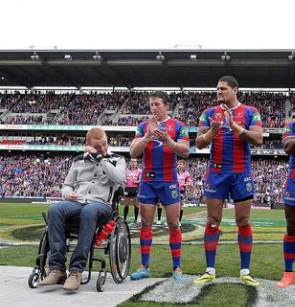
*Knights players line up as a mark of
respect to Alex McKinnon
TOUCHLINE
MAGAZINE.COM
|
41
In the context of Alex McKinnon’s
potential claim, whilst the player who
executed the tackle was found guilty
of a grade two dangerous throw by the
Rugby League judiciary, his actions
would clearly be within the scope of his
employment with his club and the club
would likely be found vicariously liable
for his actions.
Referees:
In the context of claims arising from
amateur sport, plaintiffs frequently
allege that the organiser of the match
was either negligent in failing to provide
an appropriately qualified referee to
control the match or that the organiser
is vicariously liable for the referee’s
failure to exert greater control over a
match to discourage illegal or dangerous
play. Given that an experienced
professional referee was officiating at the
match in which Alex McKinnon was
injured, allegations regarding a lack of
qualifications on the part of the referee
would not be relevant in establishing any
liability.
The relevance of any allegation as to
the referee’s failure to exert appropriate
control over the match will depend
upon the factual and expert evidence
at trial. Even if a plaintiff were able to
establish that there had been deficiencies
in the refereeing of a match, they would
still need to demonstrate that those
deficiencies caused their injury.
In a fast moving contact sport in
which injuries can be sustained in a split
second, a plaintiff is unlikely to be able
to persuade the Court that any changes
to the refereeing would have prevented
the injury. In the absence of any similar
previous conduct in the course of the
match a referee would only have a
split second to recognise that a player’s
conduct was creating a risk of injury and
then intervene and prevent the conduct
from continuing. This is illustrated in
the recent New South Wales Court of
Appeal decision in Uniting Church
NSW Property Trust (NSW) -v- Miller
[2015] NSWCA 320. In that case the
Court noted that even if the injured
plaintiff had been trained to abort a
‘track start’ dive into a swimming pool,
such training was unlikely to have
prevented her injury as she would have
only had a fraction of a second to reduce
her velocity to a safe level to avoid injury.
In short, the most likely targets of
any liability claim will be the players
involved in the tackle and their
employing club.
POTENTIAL ALLEGATIONS
OF NEGLIGENCE AGAINST
OPPOSING PLAYERS
Any proceedings arising from the
McKinnon tackle would likely involve
similar allegations to those raised in
McCracken, namely that the tackle
was performed recklessly and without
reasonable care or, at worst, with
intent to cause injury. The precise
allegations will depend upon the
individual circumstances of each claim.
In McCracken, the Court found that
the Melbourne Storm players involved
in the tackle breached the duty of
care which they owed to McCracken.
Further, the court rejected the opposing
players’ argument that the dangerous
tackle was unavoidable due to their
momentum as they commenced the
tackle. In the McKinnon case, the
Court’s finding will depend upon the
evidence of the players involved and
relevant expert evidence, most likely
from experienced coaches or players.
For example, in McCracken, the Court
had regard to an expert report from
Warren Ryan, a former professional
rugby league coach.
Causation:
While a claim against a referee
would face significant causation hurdles,
a plaintiff is less likely to face the
same causation hurdles with regard
to allegations of negligence against
opposing players. Given that the
plaintiff ’s injuries would be intimately
connected with a poorly executed tackle,
the Court will likely accept that the
actions of the opposing player, if found
to be negligent, were causative of the
plaintiff ’s injuries.
POTENTIAL DEFENCES
As the incident involving Alex
McKinnon occurred in Melbourne,
subject to any contractual provisions
regarding the applicable State legislation
for injury claims, the Wrongs Act 1958
(Vic) will be relevant to the assessment
of liability.
Obvious risk:
Section 54(1) of the Wrongs Act
provides that in a proceeding for
damages for negligence, a person who
suffered harm is presumed to have been
aware of an obvious risk unless they can
prove on the balance of probabilities that
they were not aware of that risk.
Importantly, section 54(2) provides
that section 54(1) does not apply to ‘a
proceeding on a claim for damages in
respect of risks associated with work
done by one person for another.’ Given
that McKinnon’s injuries were sustained
in a professional sporting event, it
would be characterised as ‘work’ for the
purposes of the Act and the obvious risk
defence created by section 54 (1) would
not apply.
Whilst the common law defence
of voluntary assumption of risk would
remain open to a defendant, this is
unlikely to apply as the Court is unlikely
to accept that a person would consent to
the risk of catastrophic injury.
Inherent risk:
Section 55(1) of the Wrongs Act
provides that a person is not liable in
negligence for harm suffered as a result
of the materialisation of an inherent risk.
Section 56(2) defines ‘inherent risk’ as ‘a