Basic HTML Version


25
touchline
The most fun you can have on two
wheels?
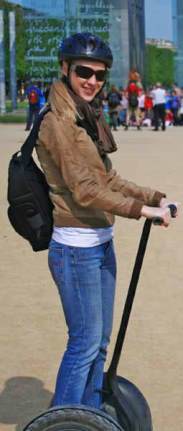
Many people may have seen a Segway,
but perhaps do not know what it was
called. Often seen on TV, particularly in
US, the Segway is a self-levelling two-
wheel personal transporter, made famous
by President George W Bush who fell off
one because he forgot to turn it on!
However, Segkind Limited, which recently
changed its name from Sedghire Ltd, is
the UK’s first and biggest provider of
Segway Rallies at 10 locations. Their
website states that they have over
160,000 satisfied customers since 2007.
Segkind have provided over 150,000
“Segway rallies” around the UK in the
past three years. The model used is
an off-road one with high mudguards
and more aggressive tyres. These rally
experiences are sold throughout the UK
through various on-line outlets and via
affinity schemes such as Tesco Clubcard.
They have been insured through
Leisureinsure for a number of years
without major incident.
On 7 December 2008 there was a Segway
rally experience being held at Flint House
in Hertfordshire. The day of the event
was a crisp winter’s morning with some
frost and ice on the ground which the
organisers took comprehensive steps to
remove. The Claimant was attending the
event. Shortly after the event commenced,
the Claimant was taking part in a group
race which comprised of each participant
doing 20 laps of a course. It was made
clear to the participants that the objective
was not to collide with the cones and that
it was a test of control rather than speed.
Despite this, when it came to his turn
the Claimant set off down the course
at a pace, lost control of his Segway
and then failed to follow either the pre-
ride training given to him or the shouted
instructions of the event organiser to let
go. Unfortunately, in the process of the
Segway spinning around, the Claimant
suffered an injury to his right ankle that
appeared minor enough. In fact, after
resting for a few minutes he hopped
back on his Segway and participated in
the remainder of the event – including
negotiating a fairly tricky off-road course!
Later the Claimant issued a claim for
damages for personal injuries.
From an early stage in the matter, panel
solicitor Steve Robb of Shakespeares
A Wheely Good Result
and Sportscover’s Senior Claims
Handler, Andrew Ancrum took the view
that this was a case to fight. Although
the Claimant’s injuries were slight and
the value of the claim fairly modest, an
admission or finding of liability could
have had a profoundly adverse effect on
the policyholder’s reputation. They had
built a successful business in a relatively
short period of time, based largely on
providing safe opportunities to enjoy a
fun but slightly risky activity. This was
the first time that anyone had suffered a
“significant” injury on one of their rallies.
Evidence was gathered which showed
the strength of the policyholder’s training
and systems, with particular emphasis
on the experience of the trainer on the
day. At the same time the evidence of
the Claimant as to weather conditions,
Touchline investigates a case of a leisure operator and its insurer taking a stand against the “blame
culture” and winning.
his reporting of the accident and his
comments on the training he had
received were carefully analysed and the
inconsistencies noted.
At the trial, the Claimant’s case was
presented. He suggested that the area
of the accident was covered in “sheets
of ice” and that the whole event was an
accident waiting to happen.
However, the District Judge delivered a
very detailed Judgment which dismissed
the Claimant’s claim in full. She took the
view that the activity that the Claimant
was taking part in was inherently risky
but that everyone accepted that without
the perceived level of risk (which the
organisers had reduced to the lowest
possible level) there was no experience.
The Judge accepted the Company’s
submission that to remove all possible
risk of injury would have made the whole
experience “tedious beyond belief”.
The fact that the participants had been
provided with helmets, body armour,
gloves, elbow pads, knee pads and shin
pads, should, in the Judge’s view, have
given the Claimant some clue that the
activity was “a bit risky”.
Commentary
Trials emphasise time and again the
importance of having properly recorded
and properly applied systems of training
and allocation of equipment. Lawyers
and Judges take account of the fact
that Claimant’s, be they employees or
participants, had been made aware of
the risks associated with what they were
doing and contain an explanation of why
the training and equipment are important.
Too often in today’s society people want
to blame someone when they are hurt.
So much more so when they can do so on
a “no win – no fee” basis. Even in a case
such as this, where someone was taking
part in an activity that he acknowledged
was inherently dangerous and for which
he had more safety equipment than the
average ice hockey player, the Claimant
still wanted to blame somebody when
he ignored the training given to him and
suffered an injury.
However, thanks to an effective system
of training and instruction on the part of
the policyholder and a robust approach
from the defence team a positive result
was achieved. In the face of the “blame
culture” it is refreshing to see that a Judge
can still accept that accidents do happen
that cannot be blamed on anyone.
Insight