Basic HTML Version


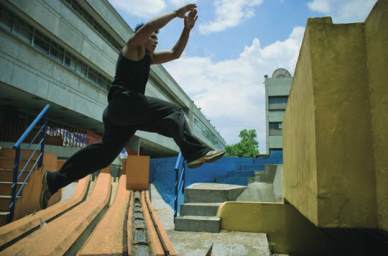
opening scene, Bond chases
a suspect in typical parkour
style: over walls, jumping from
roofs: at one point running up
a vertiginous crane. In fact,
Bond’s adversary in the chase
was none other than Sebastian
Foucan, a parkour expert
and later developer of free-
running. Free-running shares
many characteristics with
parkour but is considered more
flamboyant.
Traceurs insist that the sport
is not limited to the urban
environment, but is equally
exacting in forests or deserts.
However, it is in the cities that
the sport has found its adherents.
Urban youths in the cities of France
found a lack of organised sport no
hindrance when they could use the
environment around them as a setting
for their endeavours. The blooming of
the sport might have come after Casino
Royale, but parkour and sports like it
have been around for years. Its roots
can be found in Hebertism, an approach
to fitness and training invented by
Georges Hebert in the first years of the
20th century. He based it on the training
undertaken by the African men he saw
when stationed there. His methodology
later became one of the main training
styles for the French military in the First
and Second World Wars.
Almost one hundred years later David
Belle formalised parkour into its current
manifestation. He took Hebertism and
added a touch of Eastern philosophy to
make it a spiritual as well as a physical
challenge.
This emphasis on sport for its intrinsic
results means that if you are burning
to see the best traceurs in competition
you are going to be disappointed. No
parkour competitions are held because
traceurs believe that competing against
each other serves only to create elites,
undermines a collective community
and pushes competitors to sacrifice
their health. Rather, a key tenant of the
sport is the traceurs support of each
other.
One traceur who has recently been
in the headlines is Marcus Wilson of
Suffolk, UK. At just seventeen, the clip
he posted of his jumps and runs has
scored him a job teaching potential
parkour enthusiasts how to do the do
sport in America.
‘We started filming for fun, but as we
went on it we took it more and more
seriously,’ Marcus said.
‘It feels amazing to jump over
buildings.
‘I would love to make a living out of
parkour - it would be a fun job.
‘It is a really fun sport, keeps you fit and
you meet lots of people through it.’
In fact, it is on the internet that most
people first see the sport. Many are
hooked as soon as they see the death-
defying leaps.
For people just getting started, there is
good news and bad. Because parkour
shuns commercial deals, there is no
specific equipment required. Most
traceurs recommend good quality
trainers. On the down side, a high level
of fitness is required from the get go.
Experts suggest that as a baseline, you
should be able to do 25 crunches, 5
pull ups and have good cardio fitness.
Beginners should focus on landing
successfully and should only move
on to landing on concrete after lots of
practice on softer surfaces.
There have been surprisingly few
serious injuries due to parkour in
recent years. This is partly because of
the philosophy of the sport, where the
traceurs build up to a certain move and
never practice the sport when feeling
under the weather. Most injuries tend
to be repetitive strain injuries. Some
traceurs complain of a ‘jumper’s knee’.
Aerobic training and stretch seems to
alleviate most of these issues.
Parkour is a serious sport, in many
ways more serious than most. So next
time you see a kid scamping along the
top of a wall or leaping off a 3 metre
high building, don’t shake your head
in dismay at his foolishness. He might
just be trying to achieve personal
excellence.
Visit
www.parkourpedia.com
for more
information.
touchline
1
Spotlight on Sport