Basic HTML Version



The International eSports
Federation (IeSF) has just
released its latest rankings
for eSports.
Due to the incredible efforts
of Robert “PandaTank”
Botha, previously unranked
Robert has managed to
become the first South
African ever ranked in the
top ten according to the
world governing body for
eSports (the IeSF).
However, Robert is not
only ranked in the top ten,
Robert is ranked in fifth
(5th) position overall for the
incredibly popular game of
StarCraft II.
Only the following are ranked above Robert:
1. Jeffrey Brusi
- Sweden - 2100
2. Manuel Schenkhuizen
- Netherlands - 1890
3. Jen-Yu Chan
- Taipei - 1701
4. Andrei Nordea
- Romania - 1701
Robert , a resident of Fairlands, in Johannesburg, is a 21 year
old male, who after completing a bachelor of sciences degree
in Information Technology at the University of Johannesburg is
currently taking time off from his studies to persue his dream of
becoming a full time professional gamer.
While many such gamers in Europe find it easy to become
professional gamers, such an ambition is quite elusive for
many top South African gamers due to the lack of sustainable
sponsorship programmes.
Even the South African Department of Sports and Recreation
(SRSA) are streets ahead of many of their counterparts. The
SRSA recognises eSports as a sport in its own right and has
recognised many of the benefits that eSports have to offer.
METEORIC RISE TO BE
RANKED 5TH IN THE WORLD
Colin Webster - Mind Sports South Africa
Robert Botha - The first South
African to be ranked in the top ten by
the International eSports Federation
touchline
Insight
is leading to significant investment in eSports
through marketing and sponsorship, including
television coverage. This is unsurprising when you
learn that online streaming of major tournaments
and matches is capturing a viewership of 18-24
year olds larger than that of major cable networks
airing programs at the same.
This financial investment is leading to huge
financial rewards for players. Tournaments have
prize pools upwards of $1 million; players can
earn up to $10,000 per month by broadcasting
videos of their matches online and players can
attract major sponsorship deals and be placed
on salaries to play for their professional gaming
teams.
It isn’t just financial rewards that players are
attracting. It is also the adoration of the public.
No country illustrates this point more than South
Korea. Tournaments for Starcraft, a strategy
game, can attract 30,000 fans or more and the
tournaments are sometimes held in stadiums
once used for the 1988 Olympic Games.
These players are often seen as sex symbols,
with fans creating fan clubs and devoting websites
to their idols. There are about 300 professional
gamers in South Korea, who play for 11 teams
which are run by big business conglomerates
which pay members of their team a salary, costing
the conglomerates $20m a year.
So it seems that no longer are video games just
a hobby or a distraction from homework. Instead,
becoming a professional eSports player is now a
serious career option.
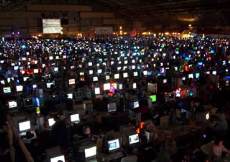
LAN PARTY: Gamers gather in their thousands
to play games over networks