Basic HTML Version


Touchline • Issue 14 •
Chinese traditional sports
offer many clues to the
dynamic and varied
culture of China.
Tug of war, Daur field hockey, yak racing, see-saw dancing, girl
chasing, dragon-boat racing, Mongolian wrestling. . .the list of
sports played throughout the centuries in China is endless. Many
of them are still played with great lustre and enthusiasm as an
expression of regional pride and a test of skill (or sanity).
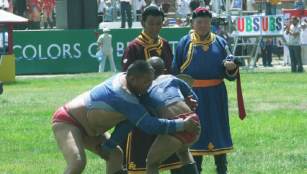
Go north to the Mongolian border and you can witness the
local form of wrestling, which has barely changed in form since
the time of Genghis Khan. There are no real time limits and
no weight divisions: you wrestle and the best man wins, most
commonly by his competitor touching the ground with any body
part other than his feet. Hundreds of wrestlers compete every
year, with the truly awesome title Undefeatable Giant of Nation
being awarded to anyone who wins that Naadam Wrestling
Competition five times.
Track west to Tibet and you can encounter the wild and possibly
very pungent sport of yak racing. Yaks seem rather docile, but
riders in this sport attest to the high speeds these beasts can
attain over short distances. During the agricultural festivals
of the high plains this event is often the most popular, as it
requires a seriously good rider to get a yak running full pelt
down a field.
Equally hair raising, but in an entirely different way, is see saw
dancing. This takes place in the extreme east of the country
where there is a large Korean population. A plank of Manchurian
ash is balanced over a trestle, and then the competitors take
turns jumping up and down, using the spring from the opponent
to jump increasingly high. Add kick moves, flowing ribbons and
traditional costumes and this sport become both beautiful and
slightly frightening. There are no safety precautions to speak of
and a hard plank of wood is the only thing to break their falls.
Back to the lands wedged between Mongolia, Russia and China
and you will find the Daur people, a tiny speck it the larger
cultural jigsaw of China. They play a form of hockey during a
festival with oaken sticks and a ball a bit larger than a cricket
ball. What makes this sport interesting is that it pre-dates the
cricket day-nighter by some years, as the Daur use a “fireball” to
see the ball during the night. The fireball is a specially designed
sphere into which is placed a burning pine cone.
Go south and the traditional sports of the heartland seem to
become more refined and dance oriented. The Lion Dance is
a typical dance/sport where competition is centred on the
flamboyance of the costumes as much as it is on the intricate
moves performed. Bamboo pole dancing is not actually an
ancient form of strip tease but a contest where girls dance
within the boundaries created by poles lying on the floor. The
tempo of the music increases and those who fail to follow
the beat are ejected. Skipping rope follows the same pattern,
but with the added complication of traditional costuming and
choreographed moves this goes well beyond the school ground
skipping we may have seen as children.
Martial arts are naturally a major part of traditional sports in
China. Kung fu is the most celebrated, but another major fighting
style is Tai Ji Quan. This style combines physical aggression
and inner calm and breathing techniques to make it a more
controlled philosophy. Tournaments take place around the
country regularly in these styles of fighting.
Finally, perhaps the most Chinese of all traditional sports is
dragon boat racing. These races are colourful and hectic affairs
that bring together speed and spectacle. The boats are adorned
with dragon heads, hence the name, and have been run on the
Yangtze River since at least the time of the first Olympics. The
boats generally contain 20 paddlers, a drummer and steerer.
The paddlers sit forwards and the races can range between
500 and 2,000 metres. The popularity of dragon boat racing has
become worldwide, with associations formed and international
competitions well established.
Chinese traditional sports offer many clues to the dynamic
and varied culture of China. Fierce competition, clear links to
the past and a sense of fun can been seen across these sports,
despite their diversity.
© Zoharby
Mongolian Wrestling in the Naadam festival