Basic HTML Version


Touchline • Issue 14 •
ack in 2008, four Harvard undergraduates decided
to tackle the third world problem of the lack of
regular and reliable access to electricity. This was a
particular issue for children or anyone who wanted
to read or study at night but didn’t have adequate lighting
available. As football is the most popular sport for children
in many third world countries, the team came up with the
ingenious idea of designing a football that when kicked would
generate and store electricity. The electricity stored in the ball
could then be used afterwards to power lights or batteries.
A prototype inflatable ball was developed in early 2009 which
had an induction coil mechanism inside. It stored energy the
same way that shake-to-charge torches do. They called it a
soccket.
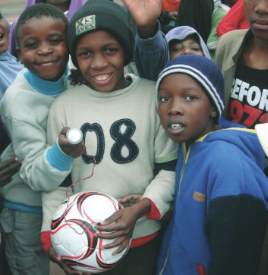
The ball was tested in South Africa later that year. The energy
output was good but not ideal. However, the children really took
to the idea, despite the fact the Soccket didn’t feel like a regular
football because of the mechanism inside.
The team decided to keep working on the idea and released a
second prototype in 2010. This one didn’t need to be inflated
and was more durable. Inside the induction coil was replaced by
a gyroscopic mechanism which made the ball three times more
energy-efficient per minute of play. However, the ball had a bit
of a wobble.
At this time the project caught the eye of former US President
Bill Clinton who called it “extraordinary - kick a ball, turn on a
light”. The project received a small amount of money from the
Clinton Global Initiative.
Jessica Matthews and Julia Silverman, two of the original creators,
decided to take the project to the next level. They founded a
company called Uncharted Play, and began hiring engineers to
not only improve the Soccket, but to also begin work on turning
other sporting products into useful tools. For example, if you can
make a football that does this, why not a basketball?
The company has greatly expanded the reach of the Soccket. The
ball is being used in South Africa and Tanzania. In Latin America,
kids are kicking Socckets in Mexico, El Salvador, Honduras and
Costa Rica.
It’s still a few ounces heavier than a regular soccer ball but
it plays more like a normal football. Further enhancements
have been made to the ball including the energy generating
mechanism. It is reported to now be able to power anything that
takes four AA batteries or less. Thirty minutes of normal play
with the soccket will power one LED light for several hours. It
also claims to be able to charge a mobile phone with just two
hours of play.
Currently, the Soccket is being made in the US, but Uncharted
Play wants to eventually move production to local markets. Not
only would that keep shipping costs down, but it would also help
create local jobs.
Perhaps the soccket provides the perfect balance to encourage
kids to exercise and study.
B
A DIFFERENT KIND
OF POWERBALL
SOCCKET
the-gadgeteer.com