Basic HTML Version


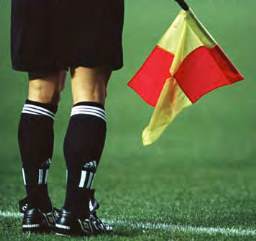
touchline
Australian Perspective
The sports field blurs the line between sport and criminal assaults in Australia
Through Legal Eyes
20
An emerging trend in Canadian case
law indicates that the courts are taking
an increasingly hard line approach on violence
on the sporting field. Recently, an 18 year old was convicted
of the manslaughter of Manny Castillo, a fellow player, during a
rugby match.
In Australia, a nation that prides itself on its sporting prowess,
the situation is a little different. It appears that where violence
occurs on the sporting filed, it is being excused as being within
the ‘hurly burley of the match.’ To date, Australian courts appear
reluctant to impose criminal convictions for those found guilty of
assault which takes place during competitive, high contact sport,
instead opting to leave disciplinary measures to internal review
processes within sporting clubs such as tribunals and other
disciplinary bodies.
The Canadian case, however, highlights the fact that players who
involve themselves in contact sport can be held liable under the
criminal law for actions that go beyond what is permitted by the
particular rules of the game. The case demonstrates that even
though internal review processes may exist, the criminal law will
nevertheless apply.
The cases show that when a player participates in a contact
sport, that player impliedly consents to the use of some degree
of force. Indeed, there is a presumption that those taking to
the field often
expect
and
agree
to some form of violence. The
questions of implied consent to assault by fellow players is the
major issue in any consideration of assault in sport.
When looking at assaults in sport and the number of subsequent
criminal prosecutions in Australia, it must be noted that the
number of cases that reach the courts after an on field altercation
are very small given the number of professional and amateur
matches that are played across Australia every year.
In 1985 Leigh Matthews, an AFL player, pleaded guilty in the
Magistrates’ Court for assault occasioning bodily harm after
breaking the jaw of an opposing player. Mathews was convicted
McAvaney v Quigley (1992)
58 Crim R 457 at 462
and fined $1,000 but the conviction was overturned on appeal.
In 1987 during a rugby match, the defendant broke the nose of
an opponent with an illegal head high contact. The court found
that a player cannot expect that every opposition player will play
strictly according to the rules. Justice Johnston overturned the
Magistrates’ Court decision which imposed a $250 fine and a
conviction. Johnston J believed that the tackle had taken place
during a match where the players were ‘revved up and excited’
and held that no conviction should be recorded.
In 1991, a Brisbane rugby league player died after he had been
tackled high while running with the ball. The man responsible
for the tackle, Heke, was charged with manslaughter. The jury
acquitted Heke after 10 hours of deliberation.
10
It was stated in
McAvaney v Quigley
11
that criminal assault is
a crime wherever it is committed. Nevertheless, the Court was
prepared to place sports assault in a somewhat different category
when it came to affixing penalty upon a finding of guilt. The court
imposed a fine of $400 but choose not to record a conviction after
the defendant broke the jaw of an opponent during a football
match.
There appears to be a consensus among Judges both in Australia
and Canada that the sports field does not evoke immunity from
criminal prosecutions. However the Australian approach to date
demonstrates that in high contact sports, the sports field blurs
the line between sport and criminal assaults. Conversely, the
Canadian approach is consistently adhering to the policy that
crimes committed on the sporting field will not be tolerated.
David Randazzo is a Senior Associate at the law firm DLA Phillips
Fox in Melbourne. Co-author, Caroline Collins is a Graduate with
the firm.
R v Matthews
(unreported Magistrates Court 1985)
Watherston v Woolven
(unreported, Supreme Court of South
Australia 21 October 1987)
10
R v Heke
(unreported QSC, 6 February 1992)
11
McAvaney v Quigley
(1992) 58 A Crim R 457
where every foul called in a rugby or soccer match is capable
of being labelled as an assault? Few would have difficulty in
condemning “off-the-ball” incidents, as they have no place in the
game being played. A leg being broken as a result of an over-
zealous, two-footed challenge in a soccer match is not so easily
pigeon-holed as “criminal”. The difficulty is in identifying the
mens
rea
, the intent to injure, which must be established before any
criminal liability follows.
The Manny Castillo case serves as a warning to those who see
contact sport as an opportunity to inflict injury on others. The
case is made all the more interesting by the comments posted at
the bottom of the website page on which the story was reported.
Those comments, all (or at least mostly) put eloquently and
with force, emphasise the distinct divergence of opinion on the
ramifications of such a decision. Having said that, the decision,
in the context of the number of injuries suffered in contact
sport every day, has to be seen as the exception rather than the
rule. One would like to think that the fallout from this case will,
therefore, be small in scale.
Stephen Hooper is a solicitor with Eastwoods Solicitors in
London.