Basic HTML Version


F
touchline
Feature
Sport in Norway
Nearly half of Norway’s population of 4.8
million are members of the Norwegian
Olympic Committee and Confederation
of Sports (NIF) and three out of four
Norwegian children regularly take part
in sporting activities. It is therefore not
surprising that Norway punches above its
weight at the Winter Olympics and that
its athletes regularly win gold medals
and world championships in winter sports
disciplines.
However, whilst Norway particularly
excels at Winter sports, which is not
unexpected given its location, topography
and climate, Norwegian athletes have
won international championships in
a wide range of other sports such as
boxing, cycling, dancing, athletics, karate,
orienteering, canoeing, rowing, sailing,
shooting, weight-lifting, swimming, rally
car driving and women’s football. And,
whilst not a sport exactly, Norwegian
student Bjørn Halvard Knappskog is the
current Monopoly World Champion having
won the championship in Las Vegas in
October last year! However, probably the
most popular of the non winter sports
are football (soccer) and handball and
Norway has produced some high quality
players in both sports.
The Department contributes towards
planning, prioritising, construction and
rehabilitation of facilities for sport and
outdoor activities. The Department also
administers the part of the profit from the
state Lotteries.
The Norwegian Olympic Committee
and Confederation of Sports (NIF) is an
umbrella organisation which organises
all national sports federations in Norway
(both amateur and elite clubs). NIF has
1.88 million memberships and consists
of 55 national federations, 19 regional
confederations, over 7,000 sports councils
and more than 12,000 clubs.
The sport federations promote competitive
sport and the district associations ensure
that sport is accessible for all. The sports
clubs spread all over Norway attract a
volume of voluntary workers who provide
the backbone of Norwegian sport.
The result of the work of these
organisations is that Norway has amuch
higher proportion of participation in
sport by its population than most
other countries and this leads
to a highly successful sporting
culture.
However, it is largely in winter sports that
Norwegians have been world beaters.
Norwegian speed-skaters, biathlon
competitors, skiers and ski jumpers have
a long tradition of being among the world
leaders as have Norway’s curling teams.
The popular participation in and
widespreaddistributionof sports inNorway
distinguish Norway as a sporting country.
Regular physical activity is engaged in by
over 40 per cent of the adult population.
Fifteen per cent take part in competitions,
and 3 per cent are top-flight competitors.
The sports movement is the country’s
predominant popular movement.
So why is sport so popular and how is it
organised?
In principle, responsibility for sport is
shared in Norway. The Department of
Sport Policy is administered under the
Ministry of Culture and Church Affairs. The
aim of all the department’s activities is to
ensure that as many people as possible
have the opportunity to engage in sport
and physical activity. Norwegians are
actively encouraged to engage in regular
sporting activities.
For the size of its population, Norway’s
performance at the Vancouver Olympics
was remarkable, finishing 4th in the
medals table with 23 medals. However,
in comparison with the historical
performance of the country at the Winter
Olympics, many would regard 4th place
as a disappointing result. In 2002, Norway
finished top of the gold medal table with
a record equalling 13 gold medals, whilst
in 1998 Norway was 2nd with 25 medals
and topped the table with 26 medals
when hosting the Olympics in 1994.
And if it hadn’t been for Norwegians many
of the current winter games would not
have been invented.
According to legend, Norwegians are born
with skis on their feet. When one takes
stock of the sports that were invented in
Norway, one can’t help but wonder if this
legend should be taken literally.
Discoveries made in Northern Norway
dating back 4.000 years describe men
Winter Olympics - Thanks to Norway
military patrol in the Winter olympics.
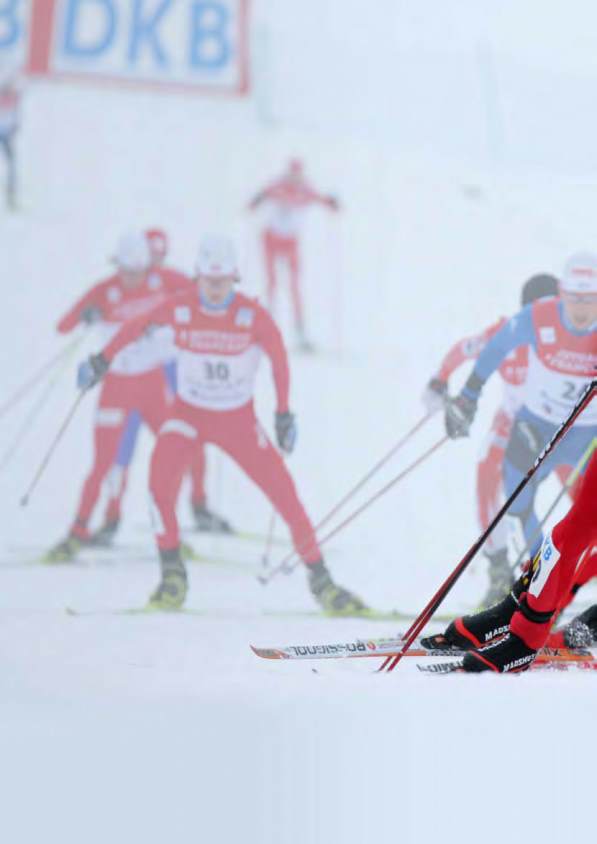
Similarly, the Nordic combined was
first practised in Norway. Throughout
the 1800s, Norwegian skiers gathered
every winter for a series of ski carnivals.
To create new challenges, the skiers
combined ski jumping and cross-country
skiing. Nordic combined was one of the
first sports introduced at the Olympic
Games in 1924.
Although the elegance of alpine
on skis made from wooden boards; very
similar to what are used today.
Ski jumping was born in the 19th century
in the Norwegian city of Morgedal. Though
the first known ski jumper was Olaf Rye,
a Norwegian lieutenant who jumped 9.5
metres, the founder of this sport seems
to be Sondre Norheim, who had
practised
u s i n g
special skis. The sport became so
popular that the Norwegian Royal Family
decided to organise the Royal Cup, which
first took place at Holmenkollen in 1892.
We can also thank the Norwegian military
for the biathlon which combines cross-
country skiing and rifle shooting. From
the 15th-17th centuries, the biathlon’s
evolution had strong ties to the military
environment. In 1767, a group of soldiers
held the first biathlon competition. In
1861, the first ski club in the world was
founded at Trysil to help local territorial
defence. Until 1960 biathlon was called
Ascending to a Peak