Basic HTML Version


F
touchline
16
The power o f consent i s no ch i l d ’ s p l ay
Legal Aid
- T h e D e f e n c e o f Vo l e n t i r e s u r r e c t e d -
Leyden v Caboolture Shire Council [2007] QCA 134
Facts
A fifteen year old boy, Scott Leyden (‘the Plaintiff’), sustained
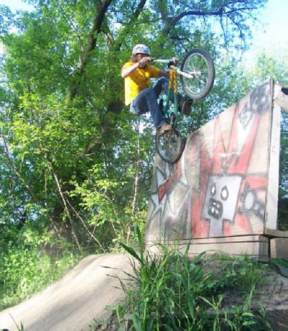
injury when riding a BMX bike on a modified BMX track on 15 July
1999 when he failed to land on the landing ramp.
The track was open to the public and was frequently altered by
other BMX riders who used the track. On this occasion when
the Plaintiff sustained injury, the track had been altered by a
professional BMX rider who lived nearby. The track was altered to
make the take off angles steeper so that a rider could be airborne
for a longer period, enabling various tricks to be performed. This
has essentially made the track more challenging and therefore
more dangerous and risky for the riders.
The Plaintiff was aware of the alteration of the track. He was in
fact an experienced rider who had been riding bicycles since he
was four or five years of age and got his first BMX bicycle when
he was ten years old. He also used the track three to five times a
week prior to the incident and had previous crashes which did not
result in serious injuries.
The Defendant Council was the occupier of the track and was
in charge of maintaining and repairing the track. The Defendant
inspected the track weekly and changed the track back to its
original condition if it detected any alterations. It knew there was
the potential for accidents and that frequent BMX riders of the
track were modifying the track, rendering it a risk.
The Plaintiff’s evidence was that the subject jump was the most
difficult he had ever performed. He had actually attempted the
jump successfully prior to the second jump in which he sustained
injuries. He admitted that the first jump was ‘difficult but was happy
that he made the landing’. The Plaintiff also stated that ‘a speed
of 100%’ would have to be achieved before making the jump as it
was a long way between the landing and the ramp, and that there
was no room for ‘second guessing’. The Plaintiff also confidently
made the remark that ‘even if there were signs warning users of
their limitation, he would still have jumped’ as he thought that he
could make it based on his assessment of his prior jump.
Is a duty of care owed by one towards a child who
has full knowledge of a risk?
In the first instance, the trial judge ruled in favour of the Defendant
because the Plaintiff had knowledge that the track had been altered
and was also mature enough to assess the risk, and therefore he
had not placed any reliance on the Defendant to provide a jump
which was reasonably safe.
On appeal, the Court of Appeal held that a duty existed which it
classed as ‘a duty to take reasonable care towards all entrants
as a class and not to each members of the class as an individual’
which is ‘based on one’s personal characteristics’.
The Court of Appeal found the duty of care to have been breached
by the Defendant as it had not taken adequate steps to ensure the
jumps were not altered and to ensure restoration of any altered
track to its original state.
Defence of Volenti non fit injuria
Even though a duty of care was found to have been owed to the
Plaintiff by the Defendant and that this was breached, the Plaintiff
still failed in his claim because the Court of Appeal ruled that the
Plaintiff had fully consented to the risk and thus could not
Background of ‘Volenti non fit injuria’
An old legal maxim ‘volenti non fit injuria’ (no injury is done to a
person who consents) which was thought extinct has been given
a new breath of life in the case of Leyden.
In order to establish this defence, it must be demonstrated that a
Plaintiff not only perceived the existence of the danger but also
that he fully appreciated it and voluntarily accepted the risk.
As it is a complete defence to a claim if raised and pleaded
successfully (and has the effect of denying one’s claimcompletely),
the court takes a rigorous approach in determining whether the
requirements to raise such a defence have been fulfilled.
Usually, a court will find contributory negligence (that is, an
apportionment of liability) rather than allowing a complete defence
(100% denial of liability).
The surprising aspect of this case is that not only was a legal
defence that rarely succeeds, successfully applied, but it was also
applied to a Plaintiff who was only fifteen years of age.
The complete defence of volenti requires a Plaintiff to prove that
he or she has:
1. perceived the existence of the danger,
2. fully appreciated the nature and extent of the specific
risk, and
3. freely and voluntarily accepted a risk.
A child is not usually held to satisfy these criteria as he or she is
usually too young to understand the nature and risk of danger and
thus will not be able to fully appreciate it.