Basic HTML Version


touchline
19
Insight
In the lead up to FIFA’s announcement of the hosts for the 2022
World Cup of Football, few outside the world of football guessed
that Qatar would come out on top. Since then, much has been
written on alleged shady practice and the impracticability of the
Gulf state hosting the event.
Now that the dust has settled, it is worth looking at just how the
event will take shape, and perhaps find some positives amongst
the confusion and concern.
For the right to host the event, Qatar has made some quite
extraordinary promises. $3 billion will be spent on stadia alone,
and the entire bill has been estimated at 645.5 million.
Somehow more shockingly, if Israel were to qualify, they would
be welcome at the event. “All nations participating in the FIFA
World Cup are welcome,” said Hassan Abdulla Al-Thawadi, chief
executive of the Qatar 2022 bid. This promise has been made
despite Qatar’s failure to recognize the Jewish state.
Alcohol will also be permitted to players and fans, a decision
running counter to Qatari law.
These accommodations seem to be a small price to pay for a Gulf
state that is rich in oil but perhaps not given the global respect it
craves.
While many of the nations whose bids failed have bemoaned the
negative aspects of the choice of venue, these concessions in
a Middle-eastern context can be interpreted as a sign of a more
open stance that could have a lasting impact.
Another positive that could come out of the 2022 event is the
safety of the players and fans. The custom-built stadia will be
in a concentrated area, and in the documentation tabled before
December, FIFAsaid that “in terms of safety and security, the Qatar
bid considers its compact hosting concept as advantageous”. In
an uncertain geopolitical climate and with the dangers of terrorism
at any major event, FIFA may have seen the positive security
possibilities of a virtual series of soccer cities built with the needs
of the organisers in mind.
Much has been made of the punishing weather in Qatar’s
summer, but this too can be looked at in context. Temperatures
can easily reach 50 degrees Celsius, which would render playing
impossible. Even at night, the heat would still sap the players’
ability to provide quality football. Qatar
has
plans
in place to air-condition the stadia in
order
to
minimize player
discomfort. Such
technology was
not considered
practical
or
feasible in the
past, so at World
Cups such as
Japan in 2002,
thematcheswere
slowed down by the oppressive, muggy heat. By adjusting the
internal stadium temperatures, players will be given the chance
to play at their peak.
One major concern about the Qatar bid was the carbon cost of
the requirement to cool stadia and training facilities, but there is a
“strong commitment to having a carbon-neutral FIFA World Cup,
especially through utilization of environmentally friendly cooling
technologies” according to the organisers. Again, the custom built
stadia have more chance of using new green technologies than
can be tacked on to existing stadia, as would have to be done in
England or Spain.
One further benefit that may come out of the event is the promise
to re-gift the stadia to parts of the developing world. Football has
long been trying to open its doors to Africa and Asia, and while
African players are now fully incorporated into the elite leagues
of Europe, Asian players are only just beginning to emerge.
Infrastructure has long been to issue that limits their ability to
produce world class stars, but the ‘trickle-down’ effect being
suggested here may have dividends in the future.
Lastly, the effect of including the Middle-east in the world game
should not be underestimated. This will be the first time a Middle-
eastern nation has hosted a major sporting event, and should they
put on a good show, the good will gained could be immeasurable.
For football to be a global sport, the Gulf is in many ways the final
frontier.
Qatar 2022 was always going to be controversial. There is room
for suspicion and perhaps even concern. But there is also potential
for this to be an exciting and professionally managed World Cup,
and one that could even break a few misconceptions.
The Qatar Bid
In Numbers
Stadia required:
12
Stadia built:
3
Stadia in development:
9
Host cities:
7
Rooms required:
60,000
Rooms contracted:
84,000
Projected sellable tickets: 2,869,000
Total expenditure budget: $645 billion
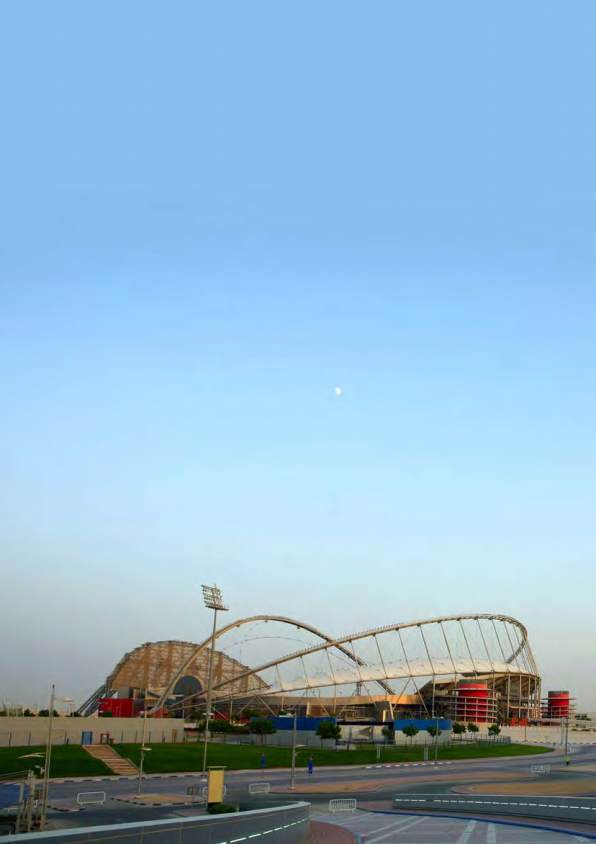
Picture: The Aspire Sports Complex, Doha, Qatar,
host venue for the football World Cup in 2022.