


Page 19 - Touchline27
P. 19
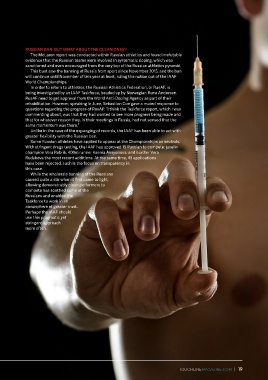
RUSSIAN BAN: BUT WHAT ABOUT THE CLEAN ONES?
               The McLaren report was conducted within Russian athletics and found irrefutable
            evidence that the Russian teams were involved in systematic doping, which was
            sanctioned and even encouraged from the very top of the Russian athletics pyramid.
               This bust saw the banning of Russia from sport since November 2015, and the ban
            will continue until November of this year at least, ruling the nation out of the IAAF
            World Championships.
               In order to return to athletics, the Russian Athletics Federation, or RusAF, is
            being investigated by an IAAF Taskforce, headed up by Norwegian Rune Andersen.
            RusAF need to get approval from the World Anti-Doping Agency as part of their
            rehabilitation. However, speaking in June, Sebastian Coe gave a muted response to
            questions regarding the progress of RusAF: “I think the Taskforce report, which I was
            commenting about, was that they had wanted to see more progress being made and
            that for whatever reason they, in their meetings in Russia, had not sensed that the
            same momentum was there.”
               Unlike in the case of the expunging of records, the IAAF has been able to act with
            greater flexibility with the Russian ban.
               Some Russian athletes have applied to appear at the Championships as neutrals.
            With stringent drugs testing, the IAAF has approved 15 Russian to compete: javelin
            champion Vera Rebrik, 400m runner Ksenia Aksyonova; and hurdler Vera
            Rudakova the most recent additions. At the same time, 45 applications
            have been rejected, such is the focus on transparency in
            this case.
               While the wholesale banning of the Russians
            caused quite a stir when it first came to light,
            allowing demonstrably clean performers to
            compete has soothed some of the
            Russians and enabled the
            Taskforce to work in an
            atmosphere of greater trust.
            Perhaps the IAAF should
            use this pragmatic yet
            stringent approach
            more often.


                                                                                 TOUCHLINEMAGAZINE.COM  |  19

